Other stuff

The work, the backstory, and a few plot twists.

This is where I keep the longer version: my standard academic bio, the story behind the Flint work, photographs, performance lore, and a few things that never quite fit on the front page.

01

My standard academic bio

Here is my standard academic bio, available to introduce me in talks and other events

Jacob Abernethy is a Research Scientist at Google Research and an Associate Professor in the School of Computer Science at Georgia Tech. He holds a 20% appointment at Georgia Tech, where he continues to advise PhD students and postdoctoral researchers, collaborate with colleagues, and occasionally teach courses.

His research lies at the intersection of machine learning, optimization, statistics, economics, and game theory. Much of his academic work has focused on online learning, learning in games, and the behavior of adaptive decision-making systems. At Google, his work has centered primarily on large language models. Since January 2025, he has been a major contributor to the Gemini Large-Scale Pretraining team, with work spanning mixture-of-experts architectures, model sparsity, and large-scale optimization.

Before joining Georgia Tech, Abernethy was a faculty member at the University of Michigan. He earned his PhD in Computer Science from UC Berkeley, where he was advised by Peter Bartlett, and subsequently spent two years as a Simons Postdoctoral Fellow at the University of Pennsylvania, working with Michael Kearns.

Abernethy is also a co-founder and board member of BlueConduit, a company that grew out of research applying machine learning to the identification of lead service lines during the Flint water crisis. Across his academic, industry, and entrepreneurial work, he has moved between the theoretical foundations of learning and optimization, public-interest data science, and the development of large-scale AI systems.

02

From Flint to BlueConduit

I co-founded BlueConduit with Eric Schwartz. We build AI and software tools for water systems, but the origin story is a little unusual: an NSF research-and-education project became a student data-science team; that team became a volunteer civic partnership during a public-health crisis; and that partnership eventually became a company.

In 2015, I received an NSF CAREER award for research connecting machine learning and microeconomic theory. One educational part of the award became the Michigan Data Science Team, which I co-organized with Eric. MDST grew quickly, pairing University of Michigan students with applied projects for outside partners. In 2016, a Google.org grant supported MyWater-Flint, a resident-facing app and website developed by U-M researchers and MDST students. Our risk assessments helped residents and officials make sense of fragmented data during the Flint water crisis.

We built statistical and machine-learning models to estimate which homes were most likely to have lead or galvanized service lines that needed replacement. An early public video explains the approach, and the research produced two KDD papers: A Data Science Approach to Understanding Residential Water Contamination in Flint in 2017 and ActiveRemediation: The Search for Lead Pipes in Flint, Michigan in 2018. The latter received the KDD Best Student Paper Award in the Applied Data Science track.

The work quickly stopped being just research. Eric, doctoral student Jared Webb, and I provided volunteer data-science and software support to Flint’s Fast Start pipe-replacement program, using the model to help select addresses for excavation and replacement. In 2018, however, AECOM and the city stopped using the model to guide digs amid a disputed transition and competing political and operational priorities. Reporting later showed that the rate at which excavations found hazardous lines fell from roughly 80 percent to 14 percent, while meeting records revealed tensions between efficient targeting and contractor incentives. In 2019, as part of the ongoing federal settlement, the city agreed to return to the predictive model and use it to prioritize as many as 5,200 addresses with the highest likelihood of lead or galvanized service lines.

After The Atlantic told the story nationally, we began hearing from other municipalities confronting the same problem. The EPA later cited ActiveRemediation in its 2022 guidance on service-line inventories, identifying Flint as a successful example of predictive modeling. Eric and I founded BlueConduit in 2019 to make these tools available to water systems beyond Flint. BlueConduit now reports that it has inventoried 5.8 million service lines across 330 communities in the United States and Canada, serving more than 18 million people. We have also expanded beyond lead service lines to include water-main failure-risk prediction.

03

Juggling, school & the long way around

I picked up magic in middle school and juggling at about fourteen. When conventional high school turned out to be a poor fit, I left Amherst Regional for Pathfinder, the program now known as North Star. In a 2020 interview with North Star co-founder Kenneth Danford, I talked about spending roughly two hours a day practicing juggling while also following my interest in mathematics.

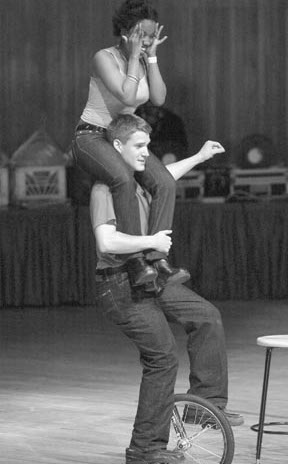
By sixteen I was getting hired for entertainment jobs; at seventeen I started street performing in Harvard Square and, after an audition, at Faneuil Hall. Somehow the act turned into a real comedy-juggling career through my late teens and early twenties—clubs, fire, a unicycle, balancing acts, and plenty of volunteers from the audience.

At UMass Amherst, I entered and won a campus comedy contest, which gave me the ridiculous but real title “Funniest Student at UMass.” That led to opening sets for Sinbad and Dave Chappelle. A 2001 UMass Magazine profile captured the collision of math student and stage performer; a saved Daily Hampshire Gazette feature followed me before the Sinbad show and described Faneuil Hall as my “Boston boot camp” in comedy and crowd work.

Meanwhile, the school story kept moving. After Pathfinder came Harvard Extension, a GED, the UMass honors program, and a transfer to MIT—then graduate school and, eventually, a professorship. I now tell the dropout story to students as a reminder that one rough educational chapter does not have to be a verdict.

Other detours: I bicycled from Boston to San Francisco with Keith Vanderlinde and Damien Burke, and spent a lot of time playing squash and racquetball.

Jacob Abernethy riding a unicycle with a volunteer seated on his shoulders during a comedy juggling performance Volunteer required
One of my unicycle-and-volunteer bits from my undergraduate comedy-juggling days. UMass Magazine archive · Winter 2001
Jacob Abernethy juggling three flaming clubs outdoors at night Fire clubs
Personal archive
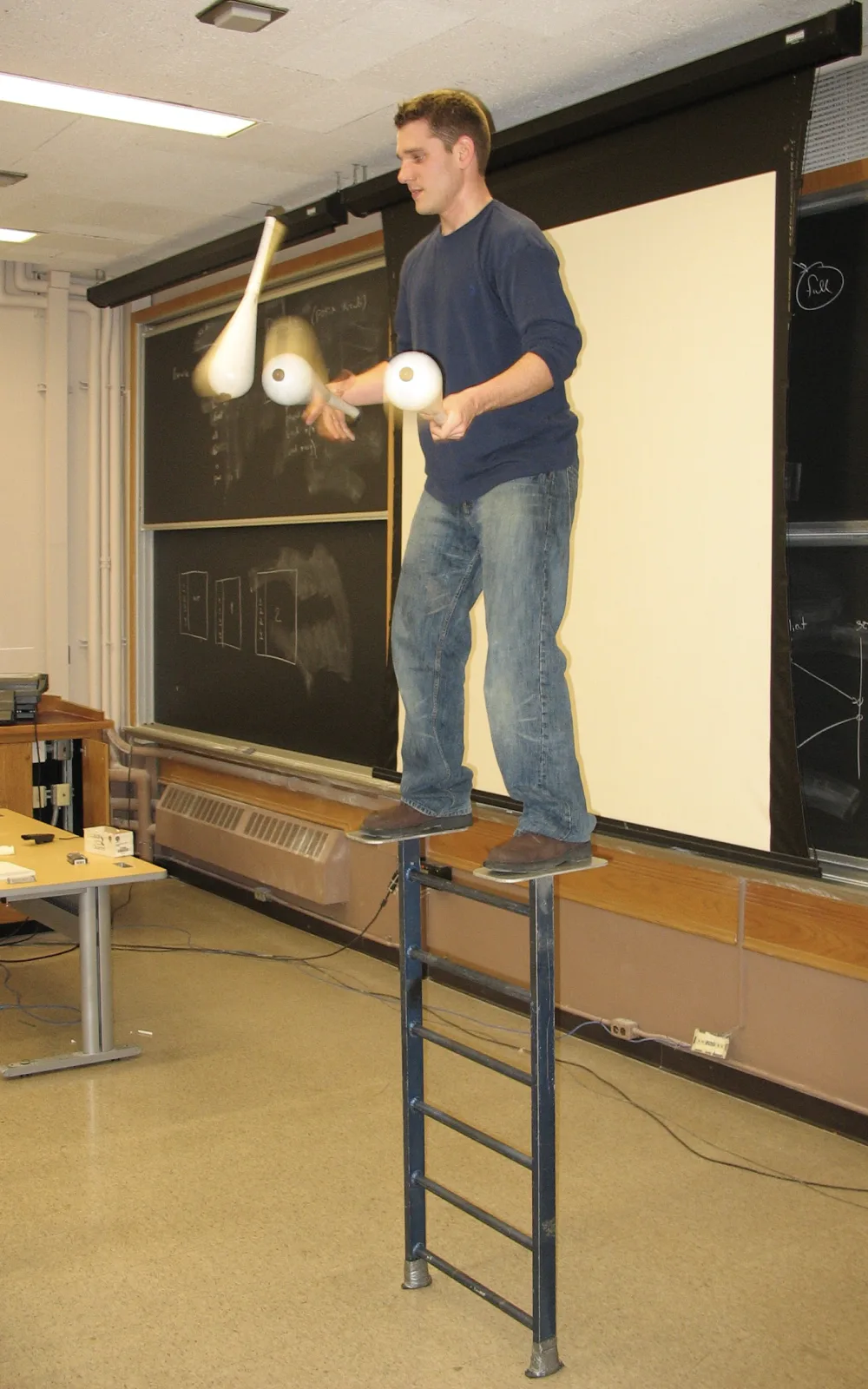
Jacob Abernethy juggling white clubs while standing on two narrow platforms attached to a ladder-like apparatus in a classroom Balancing act
Personal archive
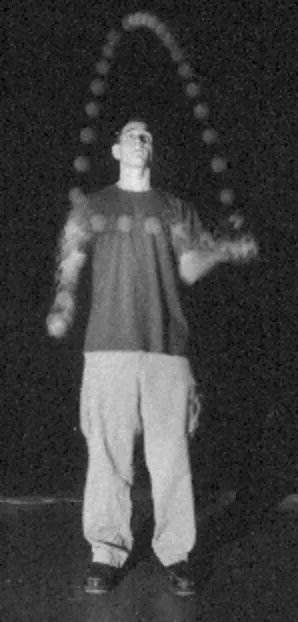
Black-and-white photo of Jacob Abernethy juggling balls onstage beside a microphone On stage
Personal archive
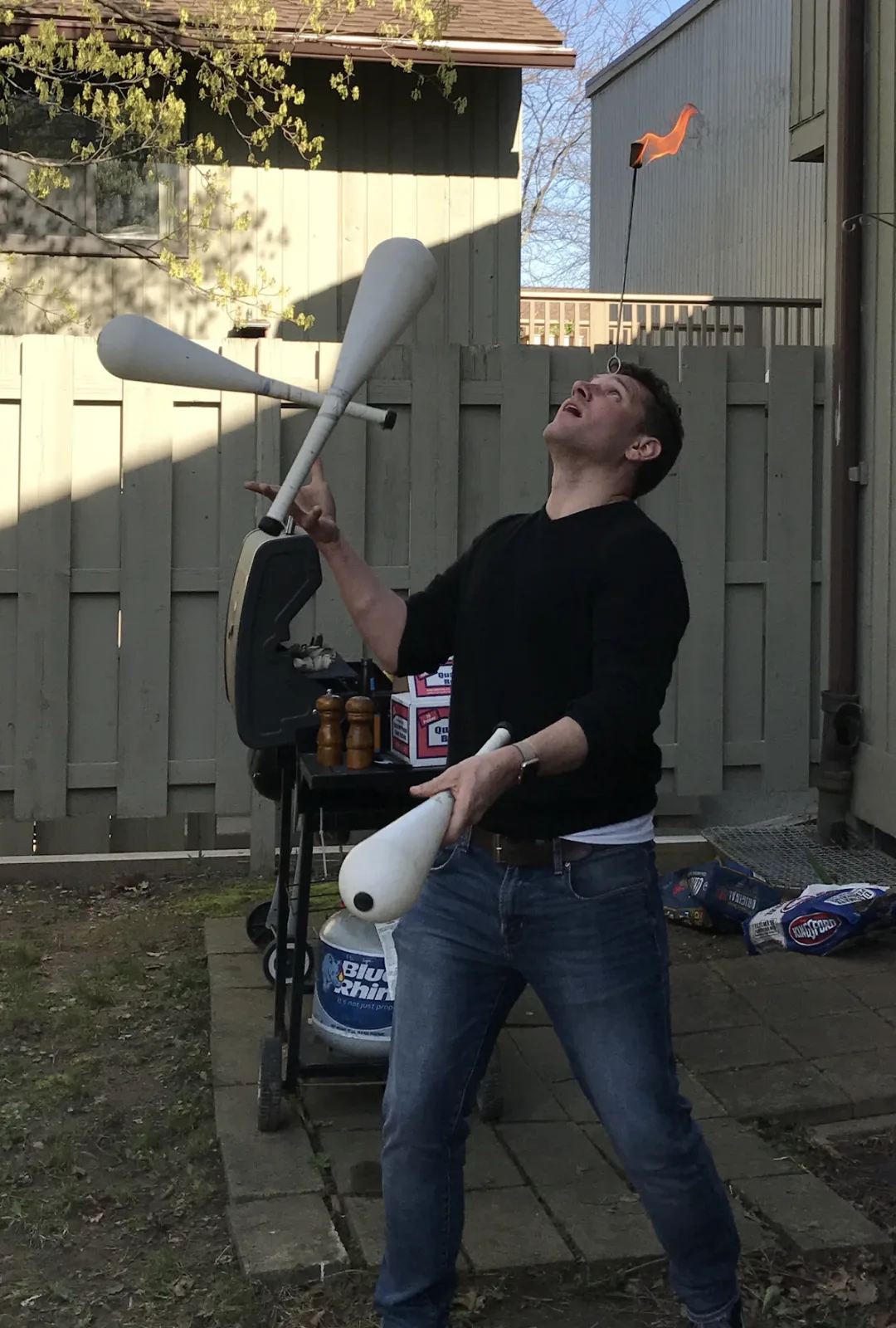
Jacob Abernethy juggling white clubs in a backyard Club practice
Personal archive
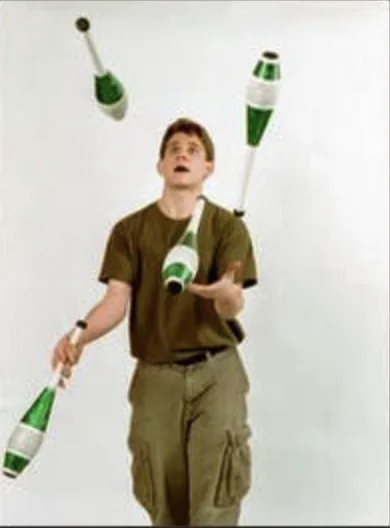
Jacob Abernethy juggling green clubs indoors Green clubs
Personal archive
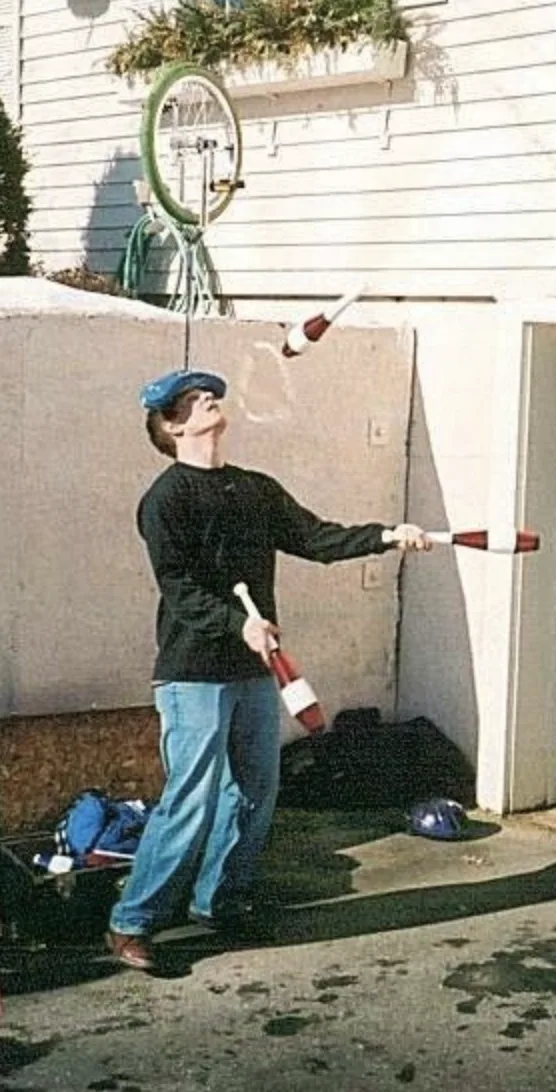
Jacob Abernethy juggling three red-and-white clubs outdoors Red-and-white clubs
Personal archive
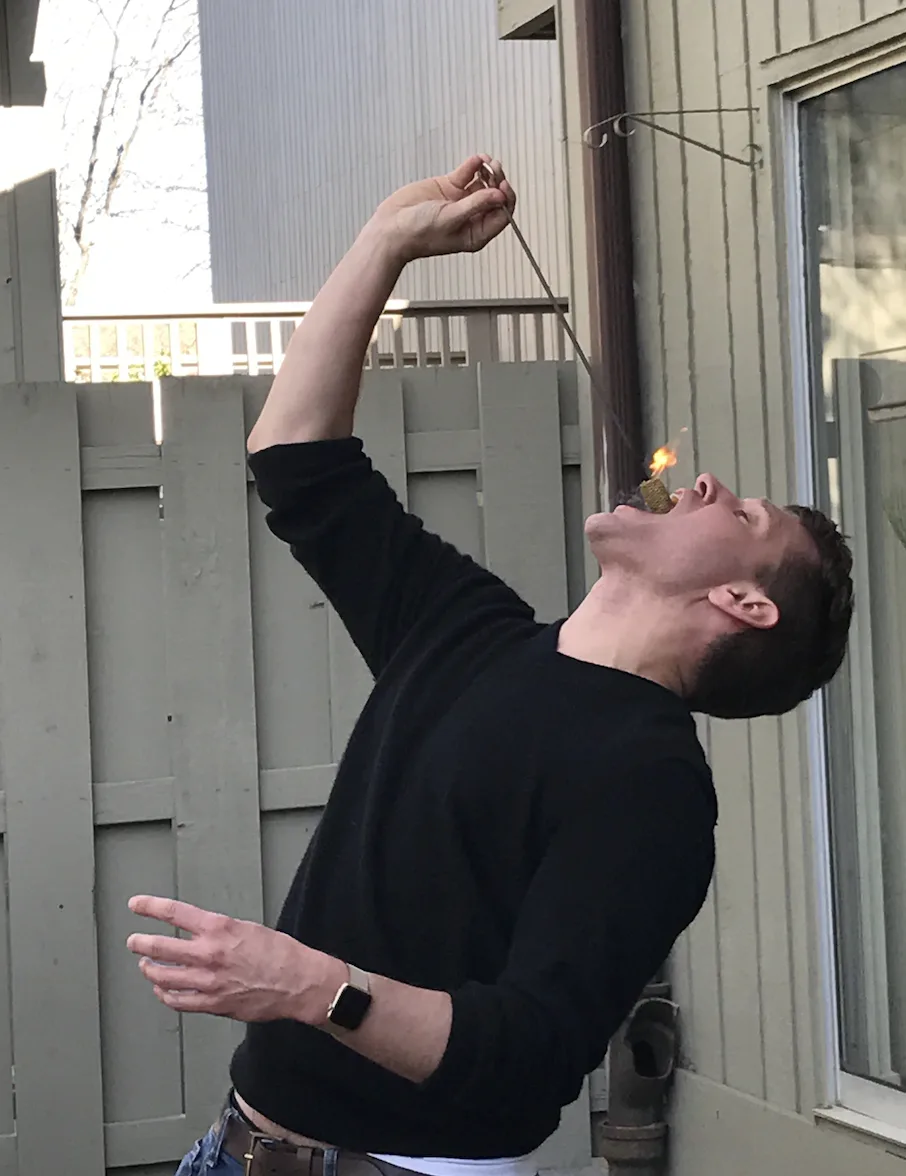
Close-up of Jacob Abernethy performing a fire-eating routine outdoors Fire eating
Personal archive
Jacob Abernethy posing with arms outstretched while balancing on two platforms atop a ladder-like apparatus Still balanced
Personal archive
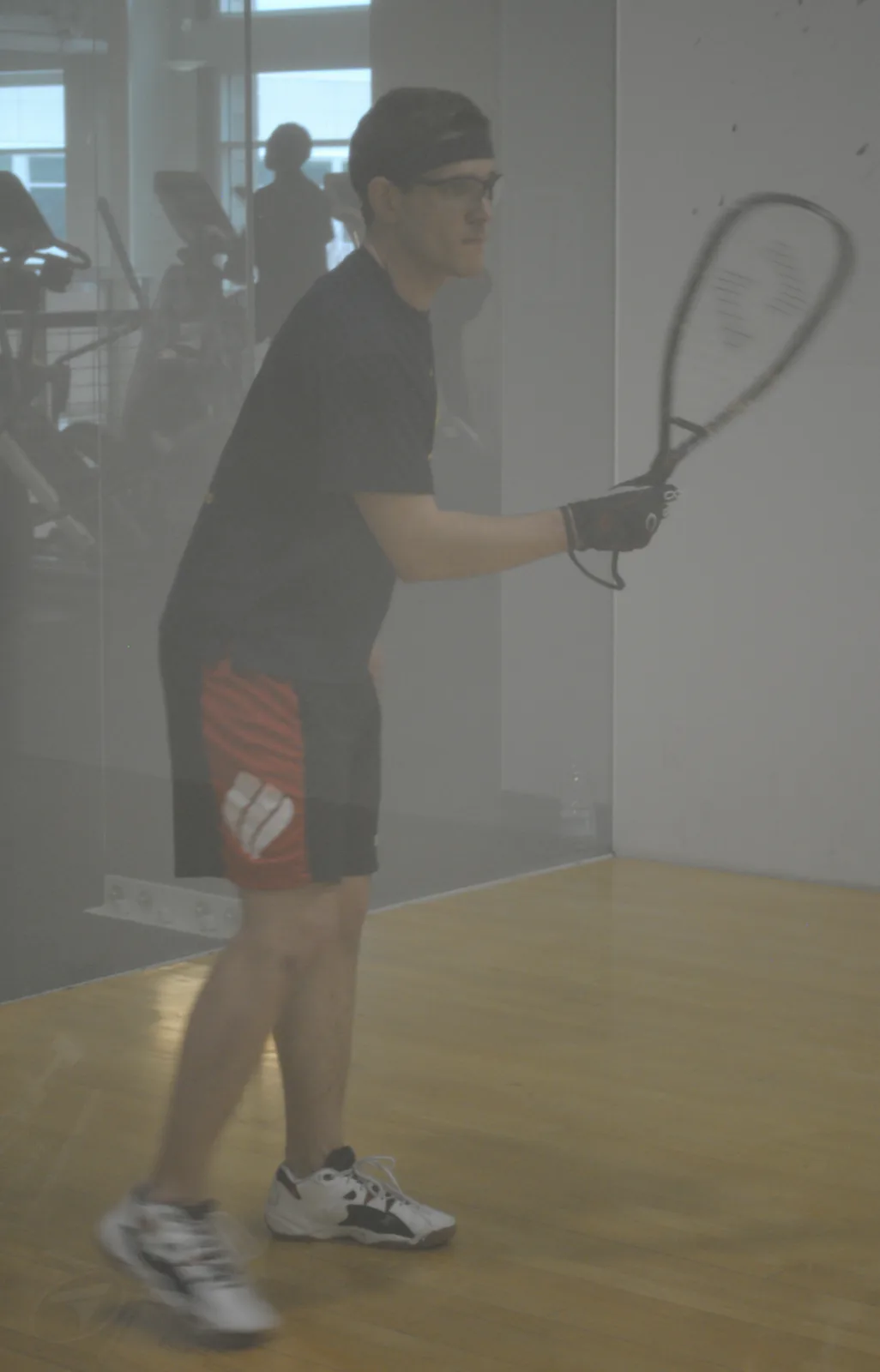
Jacob Abernethy holding a racquetball racquet on an indoor glass-walled court Racquetball
Personal archive
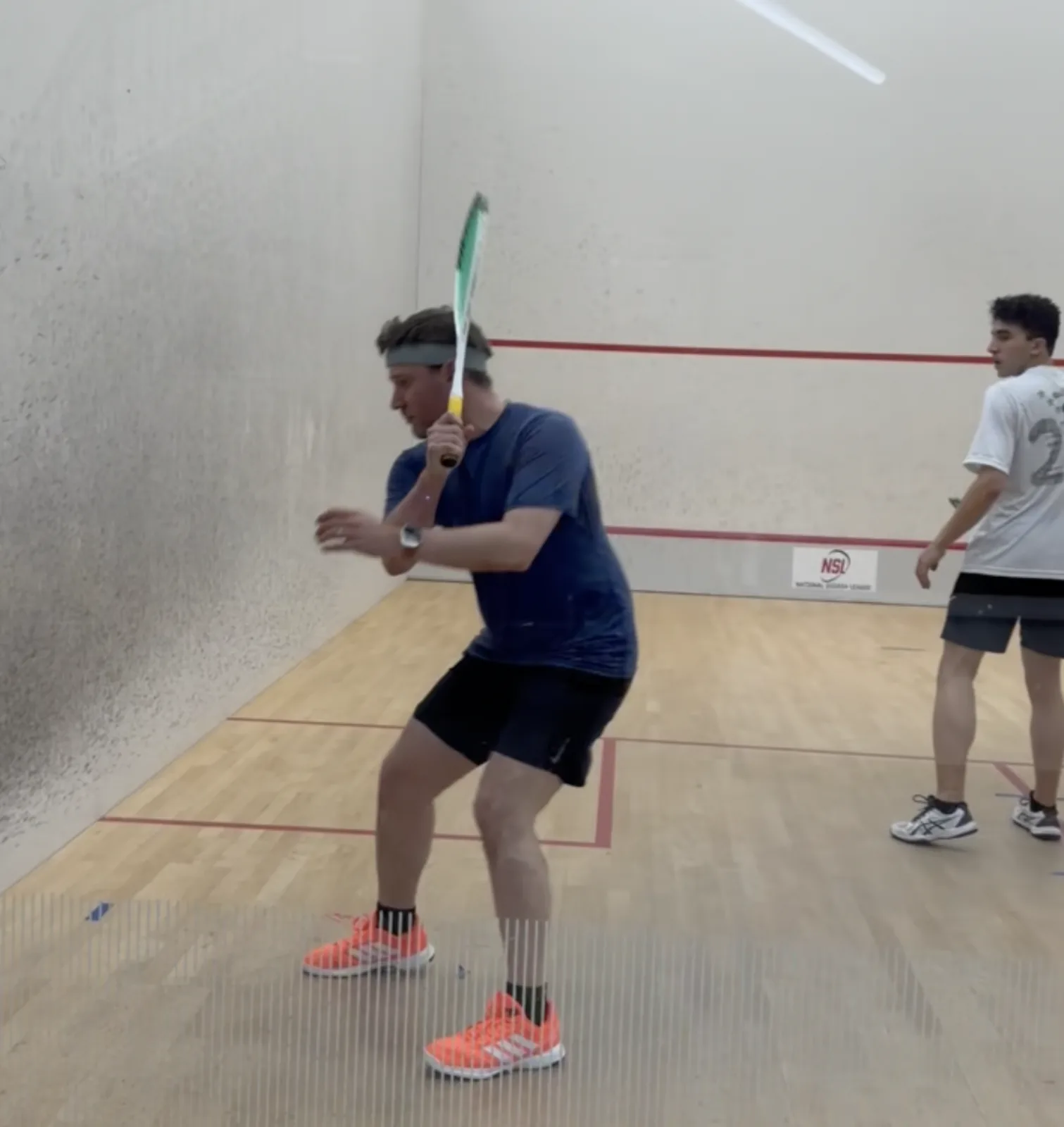
Jacob Abernethy preparing to return a shot on an indoor squash court while another player stands behind him Squash
Personal archive